 Jun Seba is dead. He’s been that way since a tragic traffic accident on February 26th of 2010, leaving an enormous legacy and a brief and highly concentrated discography in his wake. The man known as Nujabes was a legend in the ambient, jazz-infused hip-hop scene – consciously or not, many of us knew him as the force behind much of Samurai Champloo’s soundtrack, an OST so effective in its simplicity that years later, free of narrative context, it continues to stand happily on its own. That show’s artistic direction crystallized his signature style, a synthesis of hip-hop production and folk-y jazz, blended with dreamscape strings and floating piano lines – production whose artistic force often overshadowed whichever occasional guest-performer happened to drop by. Spiritual State is his first release since 2005’s Modal Soul – a six-year hiatus forcibly ended by his death – and his absence from the final stages of this album is palpable. Assembled by his musical companions from component parts found in his workshop, Spiritual State lacks the focus and polish of his finished material. A quiet, meditative work, it drifts from track to mostly-instrumental track, lingering for piano samples and five widely-spread and starry-eyed guest verses from Five Deez’s Pase Rock, longtime compatriot Cise Star and Hydeout Productions labelmate Substantial. Nujabes’ input is unfinished, but Spiritual State still stands: a calming and often beautiful work, it’s too concise to be a tribute album, too focused for a post-mortem compilation. In an inescapable way, Spiritual State is Nujabes’ eulogy, heavily steeped in his influence and haunted by his presence, but never quite an original or complete production.
Spiritual State, as the album-art suggests, bursts with colour and life. Album bookends and standout-tracks “Spiritual State” and “Prayer” mirror one another in their striking, nostalgic beauty . The former is produced by collaborator Uyama Hiroto (see: Final Fantasy), and relies on looping piano flairs and an almost Flying Lotus brush-drum sample that bring substance to its six and a half minutes; when that standup bass and clarinet kick in, the impact is undeniable, and more than a little heart-wrenching. “Prayer” feels like its response – the most complete-feeling of the album’s artifacts – and as a piano and flute duet around which the DJ builds swelling drum loops and organ responses, it results in something like a thinner version of the audio-hypnotism that he and Fat Jon conjured up with “Aruarian Dance” those years ago. In between the album flutters, world-music drums and chorus-filled pianos filling every track. “Yes” sees Pace Rock contemplating and reminiscing while 4/4 bongos and double-thumping drums fill the space beneath (and the final couple minutes of the track). “Rainyway Back Home” is dusty and expansive with its synthesizers and acoustic guitar, “Far Fowls” is plucking strings over hip-hop drumming and culminates with the same folk-hip-hop vibe that brought Samurai Champloo its fame. “Fellows” is tailor-made for rainy days in the lounge with its plinking keys, trumpets and vocal samples. There are many more effective moments too (an hour’s worth), and while the tracks can blend together imperceptibly, Spiritual State is consistent, never straying from its introspective, jazz-infused quietude.
It’s a sonically beautiful album, and for those that love Nujabes’ signature style Spiritual State will likely prove and emotional and fulfilling listen. Nujabes made his name producing music for thought, beats that went as well with mid-summer walks as they did with quiet rainy days at home. In this respect, Spiritual State doesn’t disappoint, though it meanders: some tracks (“Fellows” and “Color of Autumn”) seem to cut too soon, the album itself can feel too long and ambient for concentrated listening, and it’s missing the punch that contributions like Fat Jon’s might have delivered. While the overall listening is thematically focused, the songwriting isn’t, which sometimes results in indistinguishable tracks that feel as much like outtakes or safe experiments as they do original productions. Simply put, it isn’t his greatest work, nor does it a necessarily complete one. Which, in all fairness, it isn’t.
What do we do with Spiritual State? The name is a clue: quiet, relaxing and introspective, Spiritual State feels like a tribute to its creator. Like Nujabes himself, it cuts short, leaving us wanting more. As a capstone to his career, it’s effective. It’s beautiful and earnest, and like so much of his work it’s sad and uplifting at once. It leaves room for more, it begs the listener to retroactively explore his discography. This is likely the last we’ll hear from Nujabes, and while it isn’t his best work, as a eulogy it functions brilliantly; in listening to Spiritual State, you too might miss his style and influence. There’s a metaphorical statement somewhere in there. As a musical work, Spiritual State is expansive and humble and incomplete – and that still puts Nujabes ahead of his peers.
8.0
Originally published right here, December 2011.
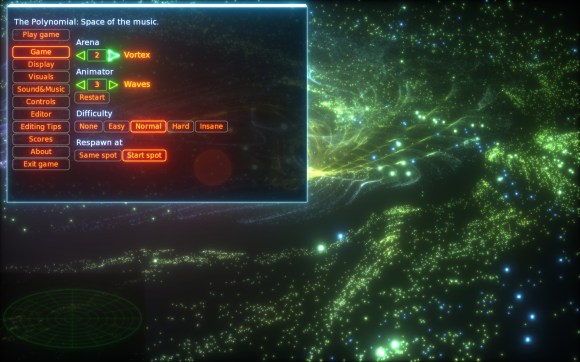 Remember that old iTunes visualizer that blew us all out of the water, all those years ago? How you could fire up your own music, hit command-T and watch those undulating shapes bend and pulse in time to your music? It ruled. Didn’t you ever imagine flying a ship through those exploding waves, spinning and diving through fractals as you hunt down ‘Nazi Robot’ Pacman-looking things? Okay, now imagine how long you could play a game like that for, and how much herbal supplement might play into the enjoyment of that experience. There: you’ve gone and written your own mental review to The Polynomial.
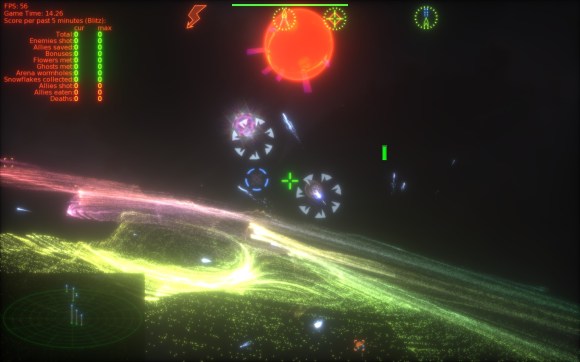 If you’re waiting for the other shoe to drop, you’re right: at heart, The Polynomial isn’t about the action or the exploration. It’s very loosely concerned even about the scores it constantly tracks, and at its core it has very little to do with interaction at all. The Polynomial is about the music – yours, specifically, piped into any level and in any playlist order you please. Set to your favourite jams, it takes on a whole new life: the fractal galaxies blossom and pulse in time to the rhythm of tracks, the absolutely gorgeous 3D visuals explode with psychedelic colours and shapes, all of them available to meticulously calibrate in the extensive visual-options menu. You’ll begin to wish the enemies, unaffected by your musical choice, would just go away so that you can float and spin in peace – thankfully, there’s an option for that. When it clicks, The Polynomial takes on an ethereal, dreamlike quality. On my first play – set to “
 There isn’t a whole lot of game here, it’s true. The Polynomial is at best an interactive musical toy and at worst an empty tech-demo. Your mileage with this novelty is going to vary wildly: there’s no incentive for high scores, no multiplayer and no sense of progression at all. Perhaps, like me, you’ll play this game for about half an hour, think “well that was neat”, and move on, returning to it whenever you find a particularly immersive electronic track you want to try out on the visualizer. Perhaps it’ll become a nightly ritual, a trance-inducing mind-hack for when you need to come down after a hard day of work, or for when your intoxicated friends need something to gaze into for a little while. The Polynomial sets out to do one very specific thing, and does it well, relegating everything else (like gameplay) to afterthought status. Essentially, it’s a very neat screen-saver, and whether or not it’s going to appeal to you is going to be determined largely by whether or not you’re big into majorly-psychedelic and ambient visual toys. Approached from the right angle, The Polynomial can be a very beautiful experience – just don’t expect any depth. ‘Try before you buy’ is the maxim of the day – thankfully, there’s a Steam demo available.
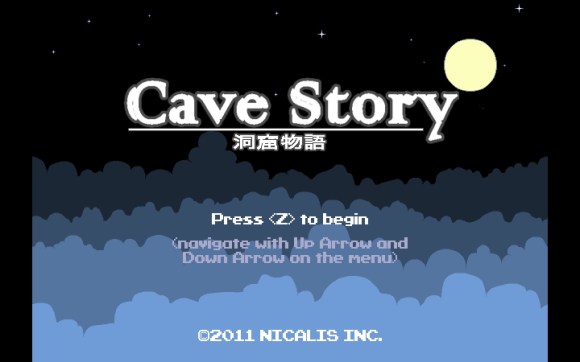 Where do I even start with Cave Story? First and foremost, it’s an indie, freeware classic: available completely for free
  Gameplay-wise, if you love side-scrolling shooters and adventure games, you’ll more or less be in platform-gunner heaven. Controls handle well, standard 4-directional jumping and shooting applies, with a glut of different weapons (upgrade-able with experience pickups) and tools (entirely secret, you’ll get no spoilers here). Platforming and gunning sections gradually ramp up in difficulty, and with effectively no on-screen instructions at all you’ll soon be plugging enemies and jumping spike-pits with ease.. at least until you hit one of the supremely challenging later bosses. There are secrets and bonus areas and difficulty sliders, and, in Cave Story+, even bonus modes of play. Taking all of these (and the various endings they funnel you towards) into account, it’s entirely likely you’ll find yourself replaying the lengthy campaign repeatedly, later surfing the wiki only to find you’ve overlooked like a quarter of the game.
 As a student of the arts, I love Cave Story+’s weirdness, its vague puzzle of a storyline, the metaphorical power of its characters and branching storylines, the painstaking effort that’s been put into its graphics and sound-production. At times lonely, at times unforgiving on its ‘Normal’ difficulty (another nod to Mega Man, no doubt), for many it may prove altogether too weird and bleak to complete – and of course, for me, these count among its greatest virtues. Two more very pure gaming experiences, Cave Story and Cave Story+ are indie classics, and deserve the attention of every platforming aficionado. Indie game of the year? Very likely.
 Transylvanilla