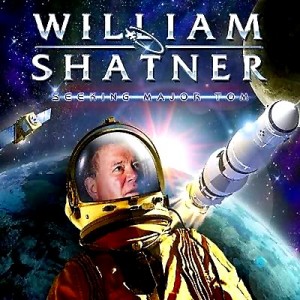
 Pop Culture Alert: William Shatner – yes that Shatner – just released a concept album about the ongoing adventures of Bowie’s Major Tom, made up of covers that famous people helped him record, and it’s actually good. Go ahead, roll your eyes! I’ll wait, because Seeking Major Tom is the silliest and most sincere spoken-world album you’ll hear this year.
Shatner’s space-age love letter is a tough one to categorize: ‘vocalist cover-album’ doesn’t do it justice, since here rarely ever sings (save his bizarre and glorious “Bohemian Rhapsody“). It clearly isn’t a linear story-piece either, since whatever cohesion Tom’s tale might possess is listener-generated, drawn from Shatner’s re-appropriated space imagery, and made up of reassembled metaphors by everyone from Hawkwind all the way to, of course, Elton John (“Rocket Man” gets a chance for redemption, don’t worry). Keenly self-aware, Will never seems to worry either way: his perpetually off-time delivery and deadpan humour carry real emotional resonance, handily one-upping his (cookie-cutter, capable-but-bland) all-star cohorts.
Coming from a man in his eighties, songs like “Iron Man” and “Spirit In The Sky” take on a new and hilarious life – and a charisma that simply begs re-listening.
B+
Originally published in The Peak, October 2011.
 When Opeth dropped Damnation back in 2003, they took what the industry calls a leap of faith: they released an album with no double-kick violence, no head-banging metal riffs, and most disconcertingly no death-growls at all. Opeth had always been a band of extreme dynamics, of classical flourishes sunk deep within the tropes of death metal and unified by prog-rock composition and the twin virtuosic voices of singer Mikael Åkerfeldt. On Damnation the setting-aside of Åkerfeldt’s growl was the elephant in the room, Opeth’s usual ferocity instead supplanted by mellotron grooves and jazz-fusion drumming (frequently with brushes). The response was overwhelmingly positive: Opeth had released their first ‘clean’ album – an oddity they had already offset with its sister piece, the previous year’s super-heavy Deliverance. Since then, each of their albums has increasingly embraced their softer aspects, and on Heritage Åkerfeldt finally cements that their ‘clean’ albums need no longer be treated with scepticism (nor apologetic companion albums): his band has matured into a genre-blending juggernaut just as capable of eliciting a reaction with organs and brush-drumming as with death metal bravado.
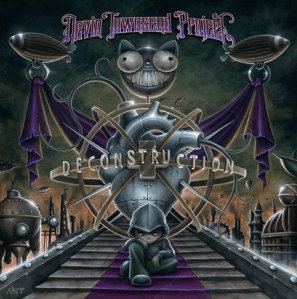 Devin Townsend has never been a subtle or predictable guy. From the incessant heaviness of Strapping Young Lad to his sometimes ambient, sometimes off-the-wall bizarre solo material, predicting the New Westminster legend’s next creative step is always a challenge. Let’s all raise praises to a deity of choice, then, that he decided to follow up on
  Transylvanilla