 Skrillex has arrived with another EP! The clown prince of wubs is back, come to wub wub wub and all that! The music community nominated him for no less than five Grammys last year, so he must be doing something right, right? Well, he’s certainly doing something. If you’re reading this, you already have an opinion on Skrillex: former singer of From First To Last, ambassador of (what we’re calling) ‘American Dubstep’, rocker-turned-electronic-musician, and effectively the single most divisive character in electronic music today. Bangarang is his fourth EP – Skrillex as an entity having existed for three years now – and he stalwartly refuses to put out an LP (which he hopes to remedy with 2012’s purported Voltage). While I’m fully willing to debate whether or not an album-less artist should be in the running for five Grammys, reviewing Bangarang is much more straightforward: with EP number four Skrillex does what Skrillex has always done – churn out a highly idiosyncratic and mercenary pile of tracks that seem tailor-made for compiling your own Skrillex debut-album, since he can’t seem bothered to amass enough track diversity to make one for himself.
Maybe I’m coming down too hard on Skrillex. Some truly great artists hung back releasing albums, that’s fair, and some of the finest albums out there were one-offs with disconcerting sequels (Endtroducing springs to mind). I’m running Sonny ‘Skrillex’ Moore through the ringer because of his meteoric rise to fame, and subsequent unwillingness to do anything with it – all of which is perfectly documented here on Bangarang. If you don’t know Skrillex, if you’ve never heard American Dubstep’s hardcore beer-swigging beer-spilling jams before, this is not a bad place to start (or more accurately, try here). One’s first Skrillexian Dubstep experience is always the best, and to his credit he does some really neat things when he gets going; it’s a rare video game fan that will deny that the first time they heard him bounce Atari samples off that signature two-step beat it got their head nodding, even less if they were playing ROMs at the time. The problem arose when his novelty wore off, which occurred about a year ago, conveniently around the time he embarked on The Mothership tour, whose tracks he largely harvests for Bangarang’s playlist. In 2012 we’re left with Skrillex at his most comfortable – and consequently least ambitious – throwing around the ideas, the chipmunk vocal samples, and the grainy-dirty synths we’ve all come to identify with him. Over and over.
Of course, the disclaimer is that if you adore Skrillex, and there are a lot of you, you’re going to feel very much at home here (add three points to the score! Ignore me entirely!). “Bangarang” itself is the sort of, uh, banger he’s built his career under, and if you’re in the mood for it (or playing Audiosurf) it’s going to get you going in all the right ways. “Right In” – whose vocal sample I swear is chanting “bite in” – sounds a whole lot like “Rock n’ Roll”, sounds a whole lot like “Scary Monsters and Nice Sprites” and… well, you get the picture, and if you loved those you’ll love this. As an album, Bangarang features more collaborations than we’ve ever heard with Skrillex (6/7 tracks), and brings some much-needed variety into his catalogue. That these collaborations all more or less work is a testament to the sort of dedication we’ll want to see on Voltage – it’s just a shame none of them seem to reach full potential here. “The Devil’s Den” was produced alongside Wolfgang Gartner, and suggests Sonny might be listening to a bit of Kavinsky and Danger these days.. but the vocals are undercooked. Vocal samples by Sirah (“Kyoto”) beg inquiries into whether or not Sonny should try his hand at Grime, but again fail to reach full potential; why not just recruit a full-on rap-friend, Skrillex? Varien’s “Skrillex Orchestrial Suite” is just plain hilarious, unintentionally self-parodic, and an attractive must-hear for fans and haters alike (Pip Williams, is that you?). If you look at it the right way, “Bangarang” even recalls Daft Punk, and “Breakn’ a Sweat” (get it?) just might vindicate itself with one very carefully-placed Jim Morrison interview sample.. when it isn’t horrifying The Doors fans by propping Jim’s corpse up on stage to deliver a frightening and out-of-place “Light My Fire” sample or two. To it’s credit, “Breakn’ a Sweat” does mix things up a bit with it’s organ and percussion samples, and is fun and infuriatingly infectious in its repetition when it isn’t plain infuriating (Skrillex synths ahoy!). To that end, it’s actually a pretty concise summary of the album as a whole: familiar, infectious, and growing a bit stale.
So it isn’t strictly the same track over and over, and it features a few nice changes of pace for a Skrillex EP (even when they don’t quite stick). Bangarang does, however, struggle with the same issues Skrillex has wrestled with his entire brief career: I, for one, would like to see Sonny locked in a room with 3/4 time and a clean synth, just to see what would emerge. Bangarang’s a swirling kiddie-pool of whomping quarter notes and 1-3 accents – which is to say it’s all two-step, which is fine – but it lacks the firecracker energy and innovation that enamored his stuff to an entire generation of club-hoppers a couple of years ago. It’s funky, vocal cuts on “Kyoto” and “Right on Time” hit hard, but are curiously empty and fairly generic. You aren’t necessarily going to be able to identify all the tracks by the time it’s 38 minutes are up, and that’s a problem. We’ve seen and heard this before with Skrillex. This is all we’ve seen and heard with Skrillex. It’s time to up the ante. Someone needs to be reminded that it is Skrillex, not From First To Last, that will be his legacy, whether he likes it or not. A while back, Sonny Moore swaggered out with something really neat. He’s been vampirizing it ever since. To share a secret, I really like the the idea behind Skrillex, he just needs to decide whether or not he’s going to make generic sex-soaked ‘Brostep’, or exciting video-game inflected two-step. It’s your call, Sonny Moore. Five Grammys.
As Jim is puppeted into saying, “IT’S [just] ALRIIIGHT, YEEEEAH IT’S [just] ALRIIIGHT.”
5.5
Originally published right here, January 2012. A very happy new year’s to you too!
 Jun Seba is dead. He’s been that way since a tragic traffic accident on February 26th of 2010, leaving an enormous legacy and a brief and highly concentrated discography in his wake. The man known as Nujabes was a legend in the ambient, jazz-infused hip-hop scene – consciously or not, many of us knew him as the force behind much of Samurai Champloo’s soundtrack, an OST so effective in its simplicity that years later, free of narrative context, it continues to stand happily on its own. That show’s artistic direction crystallized his signature style, a synthesis of hip-hop production and folk-y jazz, blended with dreamscape strings and floating piano lines – production whose artistic force often overshadowed whichever occasional guest-performer happened to drop by. Spiritual State is his first release since 2005’s Modal Soul – a six-year hiatus forcibly ended by his death – and his absence from the final stages of this album is palpable. Assembled by his musical companions from component parts found in his workshop, Spiritual State lacks the focus and polish of his finished material. A quiet, meditative work, it drifts from track to mostly-instrumental track, lingering for piano samples and five widely-spread and starry-eyed guest verses from Five Deez’s Pase Rock, longtime compatriot Cise Star and Hydeout Productions labelmate Substantial. Nujabes’ input is unfinished, but Spiritual State still stands: a calming and often beautiful work, it’s too concise to be a tribute album, too focused for a post-mortem compilation. In an inescapable way, Spiritual State is Nujabes’ eulogy, heavily steeped in his influence and haunted by his presence, but never quite an original or complete production.
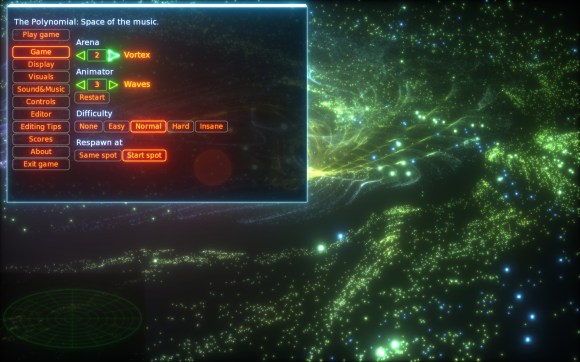 Remember that old iTunes visualizer that blew us all out of the water, all those years ago? How you could fire up your own music, hit command-T and watch those undulating shapes bend and pulse in time to your music? It ruled. Didn’t you ever imagine flying a ship through those exploding waves, spinning and diving through fractals as you hunt down ‘Nazi Robot’ Pacman-looking things? Okay, now imagine how long you could play a game like that for, and how much herbal supplement might play into the enjoyment of that experience. There: you’ve gone and written your own mental review to The Polynomial.
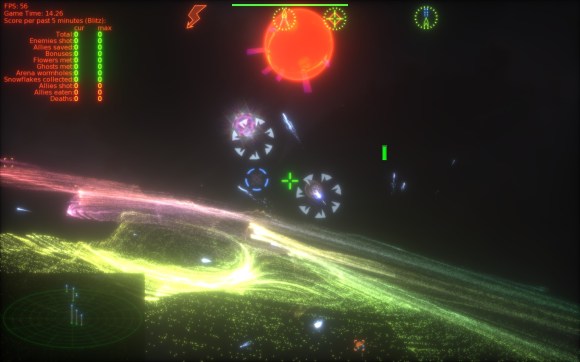 If you’re waiting for the other shoe to drop, you’re right: at heart, The Polynomial isn’t about the action or the exploration. It’s very loosely concerned even about the scores it constantly tracks, and at its core it has very little to do with interaction at all. The Polynomial is about the music – yours, specifically, piped into any level and in any playlist order you please. Set to your favourite jams, it takes on a whole new life: the fractal galaxies blossom and pulse in time to the rhythm of tracks, the absolutely gorgeous 3D visuals explode with psychedelic colours and shapes, all of them available to meticulously calibrate in the extensive visual-options menu. You’ll begin to wish the enemies, unaffected by your musical choice, would just go away so that you can float and spin in peace – thankfully, there’s an option for that. When it clicks, The Polynomial takes on an ethereal, dreamlike quality. On my first play – set to “
 There isn’t a whole lot of game here, it’s true. The Polynomial is at best an interactive musical toy and at worst an empty tech-demo. Your mileage with this novelty is going to vary wildly: there’s no incentive for high scores, no multiplayer and no sense of progression at all. Perhaps, like me, you’ll play this game for about half an hour, think “well that was neat”, and move on, returning to it whenever you find a particularly immersive electronic track you want to try out on the visualizer. Perhaps it’ll become a nightly ritual, a trance-inducing mind-hack for when you need to come down after a hard day of work, or for when your intoxicated friends need something to gaze into for a little while. The Polynomial sets out to do one very specific thing, and does it well, relegating everything else (like gameplay) to afterthought status. Essentially, it’s a very neat screen-saver, and whether or not it’s going to appeal to you is going to be determined largely by whether or not you’re big into majorly-psychedelic and ambient visual toys. Approached from the right angle, The Polynomial can be a very beautiful experience – just don’t expect any depth. ‘Try before you buy’ is the maxim of the day – thankfully, there’s a Steam demo available.
 Transylvanilla