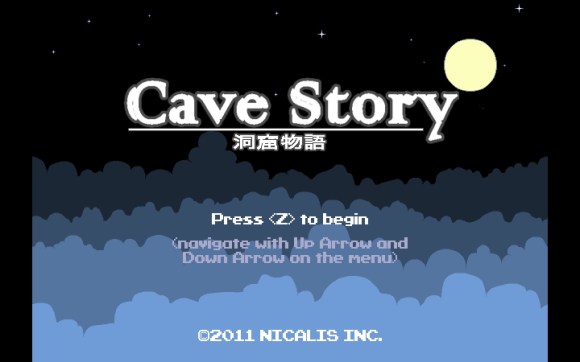
 Where do I even start with Cave Story? First and foremost, it’s an indie, freeware classic: available completely for free on the net since 2004 (be sure to grab the English language patch!), it’s an acknowledged masterpiece, the cult freeware adventure game to end all cult freeware adventure games. It’s almost ludicrous to imagine Pixel AKA Daisuke Amaya programming it over the course of five years, making the music, writing the story, and then choosing to release it for free. To any artist or aspiring game-designer, it’s an absurdly humbling work, deftly weaving its 8-bit blip-and-bleep soundtrack and minimalist pixellated artwork into one of the finest Metroidvania-style (gamer lingo for side-scrolling adventure/shooter) games you’ll ever play. Of course, that’s the freeware version, still available online, still very retro-charming and very non-HD in its soundtrack and visuals. That is, until indie-game developer Nicalis stepped up back in November (September for Macs!), re-releasing Cave Story to the PC crowd as Cave Story+, and giving it the comprehensive-overhaul collectors’ edition it always deserved.
At heart, Cave Story+ is a deeply traditional game. With every step it’s an homage to great adventure games past: Metroid’s heart containers and missiles make their appearances, the bosses are thoroughly Castlevania in their difficulty and scope, the sense of humour is utterly Japanese Gaming (as are the lovingly detailed sprites), you’ll even detect a hint of Mega Man in its more intense platforming sections. Where it breaks away from tradition is in its style: Cave Story+ is a curiously adult game with a surprisingly mature story that begins innocuously enough (amnesia!), and by its end achieves a level of metaphorical integrity and thematic density that many art-house games are still struggling to match. Humour is pervasive and quirky, but characters die, and once dead they stay that way. Balrog is adorable (and modeled after a bar of soap), but morally ambiguous. King is technically on your side, but protective and vengeful to the point of distraction. Murder happens. What begins as a very conventional critter-blaster eventually blossoms into something thought-provoking and dark, especially if you happen across one of the bad endings (of four branching endings total).
 Gameplay-wise, if you love side-scrolling shooters and adventure games, you’ll more or less be in platform-gunner heaven. Controls handle well, standard 4-directional jumping and shooting applies, with a glut of different weapons (upgrade-able with experience pickups) and tools (entirely secret, you’ll get no spoilers here). Platforming and gunning sections gradually ramp up in difficulty, and with effectively no on-screen instructions at all you’ll soon be plugging enemies and jumping spike-pits with ease.. at least until you hit one of the supremely challenging later bosses. There are secrets and bonus areas and difficulty sliders, and, in Cave Story+, even bonus modes of play. Taking all of these (and the various endings they funnel you towards) into account, it’s entirely likely you’ll find yourself replaying the lengthy campaign repeatedly, later surfing the wiki only to find you’ve overlooked like a quarter of the game.
In terms of the Nicalis rerelease, what changes have been made are mechanically minimal and aesthetically tasteful. Thanks to a graphical overhaul the game now looks much sharper, while retaining the original’s charm and general bizarreness (someone’s gone and filmed a great comparison). The soundtrack has been updated as well, and is available in its entirely through the Humble Bundle download I’ll be providing below; it’s absolutely fantastic stuff, evocative and minimalist when it needs to be, jumpy and exciting when appropriate, but all the while reinforcing Cave Story’s intentional air of mystery and stylistic oddity. It works really, really well, and I’m more than happy to have it loaded into my music player, though dedicated cult fans might find it a little too ‘softened’. However, in a nod to these traditionalists – and Pixel’s freeware intentions – the entirety of Cave Story’s original soundtrack and graphics skin is only an options-menu away. Like the new Halo: Combat Evolved rerelease, longtime fans and newcomers can flip between the two, appreciating the game however they choose and co-existing in peace (though the remix really is quite effective). Mechanically, the gameplay and level-design is identical to the original save for the unlockable post-game bonus levels, designed by Pixel/Amaya himself (which again negates complaint). In releasing Cave Story+, Nicalis has provided Cave Story the opportunity for mass-exposure it’s always deserved, while tweaking its aesthetic appeal – clearly in line with Pixel’s original intentions – to draw in an even wider cult audience. A benchmark for tasteful remakes, Nicalis leaves very, very little to complain about.
 As a student of the arts, I love Cave Story+’s weirdness, its vague puzzle of a storyline, the metaphorical power of its characters and branching storylines, the painstaking effort that’s been put into its graphics and sound-production. At times lonely, at times unforgiving on its ‘Normal’ difficulty (another nod to Mega Man, no doubt), for many it may prove altogether too weird and bleak to complete – and of course, for me, these count among its greatest virtues. Two more very pure gaming experiences, Cave Story and Cave Story+ are indie classics, and deserve the attention of every platforming aficionado. Indie game of the year? Very likely.
Go shoot some bats, Quote.
9.5
Part three of my series on Humble Indie Bundle #4, available here until about the 27th of December, 2011. Now featuring 12 whole games (and their soundtracks!) if you beat the currently $5.16 average, 5 great games and OSTs if you pay anywhere over a buck. You can’t go wrong here. Money goes to charity, games go to your Mac, PC or Linux machine.
Note: All screenshots taken by me, using the enhanced graphics exclusive to Cave Story+.
… bonus Balrog.

Originally published right here, December 2011.
 Remember
 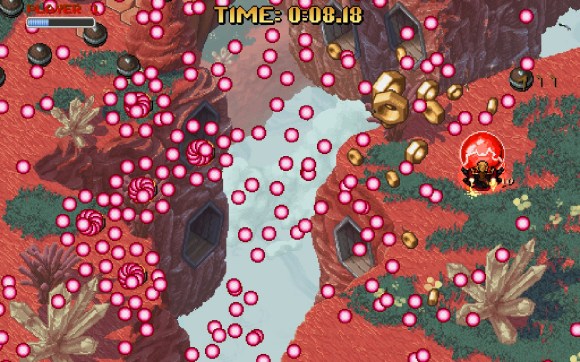 None of this ambitious setup would matter if it didn’t play like a dream: selecting from one of four unlockable ships (bought with ducats, from the “shoppe”), up to four players can collaborate on local multiplayer, flying their steampunk-y ships with keyboards, mice, and as many gamepads as you can cram into your PC (or Mac!). Keyboard control is my personal favourite as Jamestown’s overwhelming bullet-arrays frequently call for precise movement, but the mouse option is certainly appealing, and I can only imagine that play with a gamepad would be nearly sublime. In classic top-down-shooter style you’ll spend the whole game progressing upwards, firing each craft’s signature special weapon while dodging enemies and gathering ducats to activate your score and shield-multiplying “Vaunt” mode. You might even manage to figure out the proper order of destruction that causes each(!) enemy in the game to drop its ‘Special’ bonus points, a trick I still haven’t been able to riddle out for the good majority of Martians and Spaniards. Jamestown is a top-down shooter in the classic shmup tradition: it’s got screen-filling bosses, multiplayer action and more than enough difficulty levels (from Beginner to Divine) to ease anyone into the action – even though the endgame’s minimum difficulty ramps up to (hard-mode) Legendary, making the final level a true bullet-riddled challenge.
 Jamestown is hands-down my favourite recent shoot-’em-up, and one of the best indie games of the year, but like all shmups there are limitations (yes, it’s a word). For one, Jamestown is a short thrill-ride: if you’re playing on Legendary mode (as experienced players will want to), you’ll be through the story in a clean hour and a half or so. I’m no pro, so it took me about four hours, including liberal level-replays to farm ducats for unlockables (of which there are new ships, bonus levels and an alternate, farcical story mode). The multiplayer component of Jamestown is clearly designed to encourage players into the same room as one another, for that additional excitement-factor, but it’s certainly a game that would profit enormously from online play. Jamestown’s shortness is mitigated by its density, including Farce story mode, Gauntlet, Hardcore mode and multiplayer – for many, simply the pursuit of online high-score boards will last them for weeks to come. There’s also the Gunpowder, Treason and Plot DLC ($3) to extend your playtime, which I fully intend to purchase down the line. All in all, Jamestown’s weaknesses are few: if you love shmups, and you don’t mind the brevity of the campaign narrative, there’s a lot to love here, and a whole lot of difficulty levels (and nigh-impossible bonus challenge levels) to chew on.
 Remember Frequency and Amplitude? How about every artsy video-game critic’s favourite springboard, Rez? Those games immersed the player in a synesthetic experience, vastly prioritizing presentation and sensory stimulation over context. In doing so they achieved a singularity of design, uniting form and function (and tactility and audio-visual feedback) into a smorgasbord for the senses – spend time playing either and the veil of input nearly drops away, leaving only player and game in a strange, synesthetic union. Play any of them in a dark room with headphones on and you’re left with a startlingly pure experience, and one that later rhythm games like Guitar Hero struggled to emulate. Gaijin Games knows how it is: BIT.TRIP RUNNER drops right into place, swapping Rez’s Sci-Fi conceit for Atari homage and adding in a healthy dose of absurd, unforgivingly difficult platforming for a startlingly fresh platforming experience.
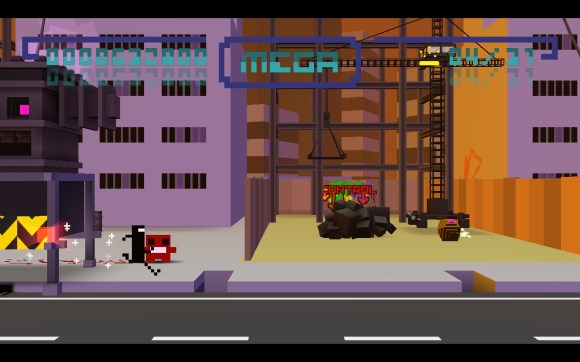 So I like BIT.TRIP RUNNER, it’s true. I’ve always been a sucker for games that prioritize style over substance, and that dearth of substance is occasionally noticeable here too. For one, its short – I’ve put in about six hours, and am on the second-to-last level, but I’ve been taking my time, trying for high scores and generally enjoying the aesthetic. It’s also brutally, at times apparently unfairly, difficult, though failure is always your fault, as the input is flawless (provided you’re working without lag). BIT.TRIP RUNNER demands nothing less than mechanical perfection, and for most players that’s going to take a very long time to develop – in a sense this helps off-put the limited amount of levels. There’s also effectively no storyline, and although exploring the rest of the series will likely remedy that issue, a little context to my hopping would have been nice. More problematic still is that like all great showmen BIT.TRIP RUNNER left me wanting more: more music, different tempos and sound-effects to play around in, more than three worlds’ worth of panoramas to explore. Its immaculately integrated sound-design might preclude user-generated content, but dangit that would be cool too. There’s no stylistic trap-door here that’s going to pull you in if you don’t dig the style either (
 Transylvanilla