Tag Archives: Music Reviews

Nujabes – Spiritual State

Jun Seba is dead. He’s been that way since a tragic traffic accident on February 26th of 2010, leaving an enormous legacy and a brief and highly concentrated discography in his wake. The man known as Nujabes was a legend in the ambient, jazz-infused hip-hop scene – consciously or not, many of us knew him as the force behind much of Samurai Champloo’s soundtrack, an OST so effective in its simplicity that years later, free of narrative context, it continues to stand happily on its own. That show’s artistic direction crystallized his signature style, a synthesis of hip-hop production and folk-y jazz, blended with dreamscape strings and floating piano lines – production whose artistic force often overshadowed whichever occasional guest-performer happened to drop by. Spiritual State is his first release since 2005’s Modal Soul – a six-year hiatus forcibly ended by his death – and his absence from the final stages of this album is palpable. Assembled by his musical companions from component parts found in his workshop, Spiritual State lacks the focus and polish of his finished material. A quiet, meditative work, it drifts from track to mostly-instrumental track, lingering for piano samples and five widely-spread and starry-eyed guest verses from Five Deez’s Pase Rock, longtime compatriot Cise Star and Hydeout Productions labelmate Substantial. Nujabes’ input is unfinished, but Spiritual State still stands: a calming and often beautiful work, it’s too concise to be a tribute album, too focused for a post-mortem compilation. In an inescapable way, Spiritual State is Nujabes’ eulogy, heavily steeped in his influence and haunted by his presence, but never quite an original or complete production.

Spiritual State, as the album-art suggests, bursts with colour and life. Album bookends and standout-tracks “Spiritual State” and “Prayer” mirror one another in their striking, nostalgic beauty . The former is produced by collaborator Uyama Hiroto (see: Final Fantasy), and relies on looping piano flairs and an almost Flying Lotus brush-drum sample that bring substance to its six and a half minutes; when that standup bass and clarinet kick in, the impact is undeniable, and more than a little heart-wrenching. “Prayer” feels like its response – the most complete-feeling of the album’s artifacts – and as a piano and flute duet around which the DJ builds swelling drum loops and organ responses, it results in something like a thinner version of the audio-hypnotism that he and Fat Jon conjured up with “Aruarian Dance” those years ago. In between the album flutters, world-music drums and chorus-filled pianos filling every track. “Yes” sees Pace Rock contemplating and reminiscing while 4/4 bongos and double-thumping drums fill the space beneath (and the final couple minutes of the track). “Rainyway Back Home” is dusty and expansive with its synthesizers and acoustic guitar, “Far Fowls” is plucking strings over hip-hop drumming and culminates with the same folk-hip-hop vibe that brought Samurai Champloo its fame. “Fellows” is tailor-made for rainy days in the lounge with its plinking keys, trumpets and vocal samples. There are many more effective moments too (an hour’s worth), and while the tracks can blend together imperceptibly, Spiritual State is consistent, never straying from its introspective, jazz-infused quietude.

It’s a sonically beautiful album, and for those that love Nujabes’ signature style Spiritual State will likely prove and emotional and fulfilling listen. Nujabes made his name producing music for thought, beats that went as well with mid-summer walks as they did with quiet rainy days at home. In this respect, Spiritual State doesn’t disappoint, though it meanders: some tracks (“Fellows” and “Color of Autumn”) seem to cut too soon, the album itself can feel too long and ambient for concentrated listening, and it’s missing the punch that contributions like Fat Jon’s might have delivered. While the overall listening is thematically focused, the songwriting isn’t, which sometimes results in indistinguishable tracks that feel as much like outtakes or safe experiments as they do original productions. Simply put, it isn’t his greatest work, nor does it a necessarily complete one. Which, in all fairness, it isn’t.

What do we do with Spiritual State? The name is a clue: quiet, relaxing and introspective, Spiritual State feels like a tribute to its creator. Like Nujabes himself, it cuts short, leaving us wanting more. As a capstone to his career, it’s effective. It’s beautiful and earnest, and like so much of his work it’s sad and uplifting at once. It leaves room for more, it begs the listener to retroactively explore his discography. This is likely the last we’ll hear from Nujabes, and while it isn’t his best work, as a eulogy it functions brilliantly; in listening to Spiritual State, you too might miss his style and influence. There’s a metaphorical statement somewhere in there. As a musical work, Spiritual State is expansive and humble and incomplete – and that still puts Nujabes ahead of his peers.

8.0

Originally published right here, December 2011.
Tagged , , , , , ,

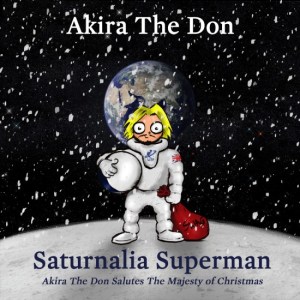
Akira The Don – Saturnalia Superman: Akira The Don Salutes the Majesty of Christmas

Hey, Adam Narkiewicz came out with another LP today (okay, yesterday), less than three months after his last one! And he’s dropped it right in the middle of Saturnalia itself, how thematically appropriate! I don’t have to go through the walkthrough this time: if you love Akira’s stuff, and you have to be a special kind of person to do this, you will have a big silly grin on your face for much of Saturnalia Superman. It’s as simply as that: fans can’t not cackle at the Nutcracker Suite sample on “Jimmy Savile Swag”, they can’t not smile at the album’s opener “A Very Merry Ho Ho Ho” when he wishes his  mother and father “and their new respective partners” a very merry Christmas. He’s infectious and ineffably positive, and the cult of personality is in full effect – even when Saturnalia Superman takes some surprisingly thoughtful and unconventional twists towards the end.

Musically, Akira’s in control on this one: he covers a good 90% of the verses this time around, flipping between the feel-good hollering of “A Very Merry Ho Ho Ho” and his trademark political flows on “Ha Satan” with ease (on what might be his most politically-charged track since “Thanks for All the AIDS“). “Jimmy Savile Swag” (Westerners, go wiki who that is) rides that hard-leaning two-step beat everyone loves these days, and Akira’s infatuation with autotune continues make an appearance. Its presence is most obviously  felt on the eyebrow-raising Envy feature “Sexmas”, which is entertaining and meandering and ends with Envy reminding us she’s “going to heat it up like a Mincemeat pie” amongst other bizarre Christmas-related sex-threats (“wrap you up with Fairy Lights, it’s gonna be good”). As on ATD 26, while autotune rears its blocky head every couple of tracks, it’s very clearly a stylistic decision: Akira’s (and Envy’s) voice flutters, it bounces around, and unlike so much autotuning it’s no attempt to fake anyone’s way into opera-level virtuosity. It’s a level of honesty and earnestness that Akira brings to all his work these days, and as on his other albums it goes hard at work, grounding Saturnalia Superman and providing a great deal of his appeal.

Clanging bells and other Christmas jolliness pervade this album (“A Christmas Movie”), but it isn’t without its surprises: most of Akira’s version of “Bleak Midwinter” is a surprisingly heartfelt vocal duet by Akira’s Cornish Welsh in-laws, proceeding a cappella before the piano, flute and strings kick in and set off what eventually builds into the album’s most beautiful track. “Bleak Midwinter” falls mid-album, and precedes another nine-and-a-half minute surprise: “17 Year Old Blonde Girl And A Bottle of Acid”, featuring a man named Issue, who really cannot sing (thankfully, he seems to know this). Like its title might suggest, it’s a trip: what begins as an odd bit of hood-meandering by Issue quickly breaks down into a heartbreaking ode to a forgotten female trip-mate, delivered by Akira himself. The album’s greatest and most sobering moment, it’s a strange and thought-provoking piece, sprawling its narrative across several harrowing minutes and telling a story that isn’t always easy to hear. When Akira tells us that he’s opening Christmas presents with his mum and little brother and the “wrapping paper seem[s] to crawl up [his] arm like tentacles” the psychedelic imagery combines with our notions of Christmas’s assumed innocence to shock and disorient the listener. It’s extremely effective stuff, and lends heavy dosage of reality to the typical Christmas Album format.  In a sense, all of Saturnalia Superman follows this model: simultaneously celebrating the holiday season (and life!) while offering thoughtful reminders of its reality – murder, drugs, rampant commercialism and Akira’s trademark resolution to carry on (closer “In The Morning”) all make appearances here.

Of course, Saturnalia Superman wouldn’t manage to be an ATD LP if it didn’t somehow pull off being a party, even in its bleakest moments. It isn’t his most consistent album – much of his merry band of thieves is missing (can we imagine Christmas Big Narstie? Let’s.) – but Saturnalia Superman can’t help being an enjoyable time, even in its more experimental and meandering moments. Another solid entry in the ATD catalogue (though not strictly ATD 27), Saturnalia Superman is supremely topical during the season, and offers several tracks destined to prove their staying power in the Akira catalogue. It goes by quickly, a widely various series of Christmas-themed sketches in the life of one more dude trying to get by. It’s an Xmas album for people that live in the real world, who’ve had experiences, that aren’t much for major commercialism and don’t know what to think about God but know they like hip-hop and spending time with their folks. How much more can we ask for for Christmas than that?

7.5

Bonus Level:

Saturnalia Superman As a Christmas Album is a grand triumph, intelligent, heartfelt and earnest. As a simultaneous lover and critic of the Christmas season, this sort of thing really does it for me. I do love it, but in the above review I had to acknowledge its faults. As a big Akira fan and a big Christmas fan, though, I have to say this is definitely going to be spinning all holiday season. Much more interesting, dense and listenable than any Christmas album I’ve heard in years. Highly recommended. 

Based solely as a Yuletide experience, Saturnalia Superman gets a  coveted 4.5/5 baubles. Do with that as you will.  

Akira the Don provides many of his services over the internet: his website is here, and he would love it very much if you’d cop a free listen off the stream, and then buy yourself some copies. 

Originally published right here, December 2011. 

Tagged , , , ,

Nightwish – Imaginaerum

Time for another album by that band, with the operatic female singer, with the mythological imagery, with the symphonic arrangements and the heavy-metal guitars! Evanescence! Okay, it’s Nightwish, but you get the joke – a band has to work real hard to make a case for itself in female-led symphonic metal these days. When it comes to bands like the two above, the similarities are multitude (though Evanescence technically beat Nightwish to the table by a year): female vocalist, heavy orchestra, operatic vocals, mystical imagery, and a penchant for power chords. The defining make-or-break difference, of course, is ambition: Nightwish is Finland’s most profitable musical export, they were a foundational influence to bands like Epica, they’re charged with crystallizing the female-led symphonic metal genre – in a real sense they helped open symphonic metal to a female audience (and girl vocalists!) without letting it suck. For their last two albums they’ve recruited Pip Williams – the noted orchestral director whom at this point might as well be a band-member – and while doing so mysteriously and ceremoniously dumped vocal powerhouse Tarja Turunen for Anette Olzon (at 40, six years her senior), to the chagrin of many a longtime fan. Imaginaerum is Olzon’s second album with the band, after 2007’s just-okay Dark Passion Play – which included one of the most epic female-led symphonic roller-coasters out there – but here on Imaginaerum she really hits her groove; to hear Metal Hammer tell it, this is Metal Album of the Year. To hear the sales figures tell it, Imaginaerum went double-platinum in Finland on the day of its release. High praise, indeed – so is Imaginaerum Nightwish’s finest hour, and symphonic metal album of the year? If you know what you’re getting into, and you don’t mind the odd timpani-drum or song about mermaids, it just might be.

For many, as on Dark Passion Play, Olzon’s inclusion is going to be the major sticking point of this album: Tarja was a vocal juggernaut, her super-operatic voice overflowing from tracks and helping to make Nightwish one of the most idiosyncratic symphonic metal bands out there (even while unbalancing a large part of their efforts). Some of that idiosyncrasy is indeed lost with Olzon, and at times her considerably more-conventional vocals do tend to take backseat on these tracks, at times lost in the bombastic choral and orchestral arrangements (when she isn’t thoroughly over-dubbed) – and this would be a huge problem if she didn’t recognize her weaknesses and tune her presentation accordingly. When Olzon connects, the results are absolutely some of Nightwish’s coolest moments yet: “Slow, Love, Slow”, of all things, was inspired by David Lynch’s Twin Peaks and emerges as a slithering bluesy romantic meditation (written by Audrey, we can only assume). “Storytime” is almost an homage to their old ways, stomping out of the gate accompanied by Nightwish’s trademark power-metal riffage and an orchestral arrangement that vaults Olzon’s multi-tracked love-letter to Literature into Imaginaerum’s obligatory Finnish chart-topping single, and features a poppy chorus the likes of which Tarja could never have brought us (with a video that begs us not to take them seriously). “Taikatalvi” gives us exclusively male vocals in Finnish, a rarity and a lullabye (and a Moomin tribute) whose orchestrations are subtle and beautiful. When Imaginaerum falls into place, as it often does, it reveals itself as Nightwish’s most thematically and instrumentally confident work yet.

Speaking of cohesion, would this be a Transylvanilla review if Imaginaerum weren’t a concept-album? Of course not: loosely (or tightly, if you ask the band), Imaginaerum is the story of a dying composer imaginatively reliving key moments of his life, which was apparently a Tim Burton film. That isn’t a dig or a joke either: Imaginaerum really is an upcoming film (by “The Islander” director Stobe Harju), and the band has expressed its heavy reliance on a trifecta of influences including Tim Burton, Neil Gaiman and Salvador Dáli (let’s call this The Holy Gothic Trinity, eh?). These influences do emerge as well, with Pip Williams’ Elfman-tinged orchestrations doing an fantastic job of bringing life to the otherwise now-generic Nightwish formula of blasting horns and choral refrains – in fact, the bonus disc contains nothing but his orchestrations. It stands handily on its own, too – for Tarja devotees, the bonus disc may prove a far superior album. Good luck actually following the storyline (they swear its in there!): lyrically this is very much a Nightwish album, all magic and fantasy and imagination, and I can’t say that even after several listens any track is jumping out at me lyrically the way “The Islander” did back on Dark Passion Play, though their dabbling in intertext certainly appeals to me. Despite this, some tracks still jump the shark entirely – the 13-minute “Song of Myself” is, as my significant other described it, “an abomination and an insult to Walt Whitman,” and while I might not completely agree, it certainly positions itself as an homage (to the point that some are confusing it for a read-through of the famous poem itself). Sadly, if you know Whitman, it entirely fails to stand up under close lyrical inspection. Mind, if you don’t know Whitman (or ignore the reference) at thirteen choir-filled moments it certainly positions itself as the album’s apex, and is at this point prototypical of their style (which means good). Like all Nightwish releases, Imaginaerum stands up for itself most effectively when it’s shoving power-chords under its enormous orchestral, folk, and mythological influences, which thankfully it does on every single track.

So, is Imaginaerum Nightwish’s greatest work? Does it deserve Metal Album of the Year in a world where bands like Agalloch and Amebix exist to make music? Well, not necessarily. Make no mistake, Imaginaerum is Nightwish’s most musically diverse entry yet, to the extent that Pip Williams was given free license to craft this for the album’s closer and came up with a practically Disney orchestral sing-along of every track on the album (beautiful, silly). Speaking of Disney, like much fantasy and mythologically-entrenched work, it can be very hard to take Nightwish seriously, especially during their more heady narrative moments or when you find out they inked an endorsement deal with a Disney Comics Magazine to promote the album’s most potentially pretentious and boring, poppy track, “The Crow, The Owl and The Dove”. The extensively fantastic lyrics (in the fictional sense) can be exhaustive and occasionally threaten to fall flat on their mystical faces, as on the power-metal “Last Ride of the Day”. If you’re a big Walt Whitman fan (or a scholar), you’ll need to acquire the orchestral mix of “Song of Myself” and swap it into the album’s playlist to retain your sanity. As with all Nightwish work, Imaginaerum is over-the-top, bombastic and carries very little of what might pass for subtlety. Then again it’s Nightwish, dammit, and whether or not this is a problem for you will depend almost entirely on whether or not you wish Evanescence would be more fantasy-oriented, more sensory-overloading with their instrumentals, and whether or not you can stomach anyone but Tarja (the-vocal-Atom-Bomb) on the mic.

If, as a listener, you don’t approach Nightwish just so, you’re going to laugh it off as poppy faux-literature – which is fine, as the entire symphonic metal genre seems to labour under that yoke. Yes, they’re a new band now, and that turn is going to be a bit jarring to anyone that disliked or flat-out avoided Dark Passion Play; Nightwish isn’t Tarja’s house any more, and hasn’t been for six years. If, however, you’re prepared to listen to what might be Nightwish’s most ambitious, thematically cohesive and orchestrally exciting work yet, then yes, there’s a very good chance you’re going to love it. You’ll probably even give it Symphonic Metal Album of the Year. Take Imaginaerum at face value, remember it’s alright to have fun with your fantasy tropes and your fantasy music. There’s nothing wrong with re-reading The Golden Compass or Bay Wolf while you’re at it. Pretend you’re a wide-eyed kid again, that things like snow-covered crows’ wings and a number called “Turn Loose the Mermaids” don’t have to be condescending or hokey. Christmas is coming, and fantasy just seems to fit the mood: if you aren’t religiously inclined (or are symphonic metal inclined), let Nightwish dethrone Trans-Siberian Orchestra as your twinkling Festivus music this year. They’ve worked hard, they’ve earned it.

8.5

Editorial note: Yes they’re a guilty pleasure. No, it isn’t my favourite Nightwish album. “Oceanborn” is, duh. This doesn’t come out in North America until January 10th, 2012, so don’t go looking for it on store shelves. How did I get ahold of it, you ask? Haahaha Vancouver is in Finland, silly. Hyvää joulua!

PS. You and me? We’re seeing this movie when it comes out. 

Originally published right here, December 2011.

Tagged , , , , , ,
Design a site like this with WordPress.com
Get started