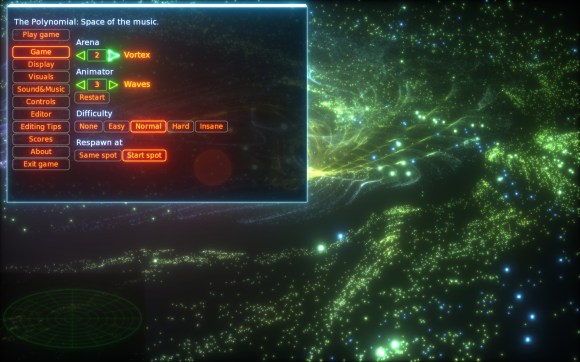
 Remember that old iTunes visualizer that blew us all out of the water, all those years ago? How you could fire up your own music, hit command-T and watch those undulating shapes bend and pulse in time to your music? It ruled. Didn’t you ever imagine flying a ship through those exploding waves, spinning and diving through fractals as you hunt down ‘Nazi Robot’ Pacman-looking things? Okay, now imagine how long you could play a game like that for, and how much herbal supplement might play into the enjoyment of that experience. There: you’ve gone and written your own mental review to The Polynomial.
Yes, they really are called “Nazi robots” in-game (neon Pacmen, for all intents and purposes), and along with friendly speed-boosting Ghosts (jellyfish you can shoot or eat) and aliens, they comprise the entire cast of The Polynomial. There are powerups to augment your ship’s performance temporarily, as well as various landscape features to hide within or fly into to switch levels. There are 39 slightly-different space-scapes to pilot your first-person craft through, each of which is just as psychedelic and vast and empty as the last. There are numerous difficulty levels, ramping up to the game’s recommended ‘Insane’ mode, in which you’ll face near-instant death at the hands of your pulsating companions and their laser guns… And that’s it. That’s the entirety of whatever might pass for a campaign in The Polynomial: the pursuit of two different types of enemies, over 39 functionally-identical maps, set to an electronic soundtrack, with a minimal amount of interactive elements, and absolutely zero context. Sound like that visualizer-game we were talking about?
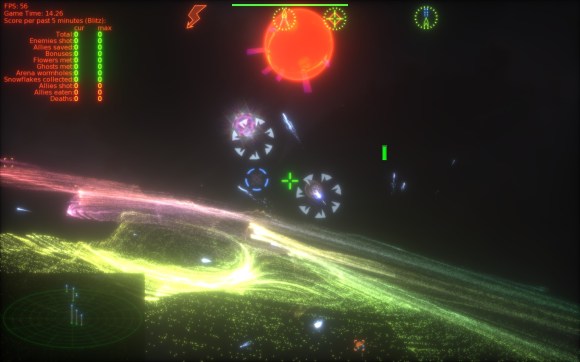 If you’re waiting for the other shoe to drop, you’re right: at heart, The Polynomial isn’t about the action or the exploration. It’s very loosely concerned even about the scores it constantly tracks, and at its core it has very little to do with interaction at all. The Polynomial is about the music – yours, specifically, piped into any level and in any playlist order you please. Set to your favourite jams, it takes on a whole new life: the fractal galaxies blossom and pulse in time to the rhythm of tracks, the absolutely gorgeous 3D visuals explode with psychedelic colours and shapes, all of them available to meticulously calibrate in the extensive visual-options menu. You’ll begin to wish the enemies, unaffected by your musical choice, would just go away so that you can float and spin in peace – thankfully, there’s an option for that. When it clicks, The Polynomial takes on an ethereal, dreamlike quality. On my first play – set to “The Music Scene” by Blockhead – I was completely drawn in and disoriented and amazed; at it’s best, The Polynomial is an experience like few others, profiting from its general sense of plotlessness and spatial ambiguity to hypnotize and immerse the player.
 There isn’t a whole lot of game here, it’s true. The Polynomial is at best an interactive musical toy and at worst an empty tech-demo. Your mileage with this novelty is going to vary wildly: there’s no incentive for high scores, no multiplayer and no sense of progression at all. Perhaps, like me, you’ll play this game for about half an hour, think “well that was neat”, and move on, returning to it whenever you find a particularly immersive electronic track you want to try out on the visualizer. Perhaps it’ll become a nightly ritual, a trance-inducing mind-hack for when you need to come down after a hard day of work, or for when your intoxicated friends need something to gaze into for a little while. The Polynomial sets out to do one very specific thing, and does it well, relegating everything else (like gameplay) to afterthought status. Essentially, it’s a very neat screen-saver, and whether or not it’s going to appeal to you is going to be determined largely by whether or not you’re big into majorly-psychedelic and ambient visual toys. Approached from the right angle, The Polynomial can be a very beautiful experience – just don’t expect any depth. ‘Try before you buy’ is the maxim of the day – thankfully, there’s a Steam demo available.
5.5
Full disclosure: I grabbed it on today’s Steam promotion for $2.50, and it’s compatible with a Gift-Pile achievement. That’s about the right price (normally an optimistic $10). I don’t often play The Polynomial, but when I do, I prefer The Unseen.
Originally published right here, December 2011.
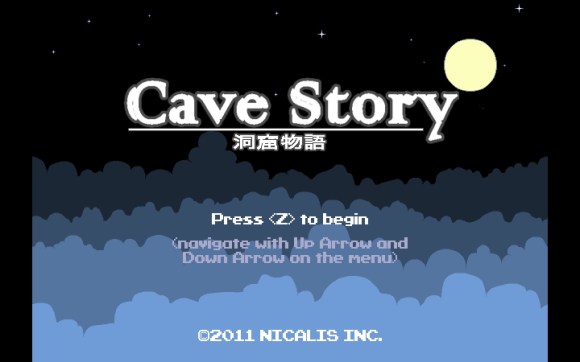 Where do I even start with Cave Story? First and foremost, it’s an indie, freeware classic: available completely for free
  Gameplay-wise, if you love side-scrolling shooters and adventure games, you’ll more or less be in platform-gunner heaven. Controls handle well, standard 4-directional jumping and shooting applies, with a glut of different weapons (upgrade-able with experience pickups) and tools (entirely secret, you’ll get no spoilers here). Platforming and gunning sections gradually ramp up in difficulty, and with effectively no on-screen instructions at all you’ll soon be plugging enemies and jumping spike-pits with ease.. at least until you hit one of the supremely challenging later bosses. There are secrets and bonus areas and difficulty sliders, and, in Cave Story+, even bonus modes of play. Taking all of these (and the various endings they funnel you towards) into account, it’s entirely likely you’ll find yourself replaying the lengthy campaign repeatedly, later surfing the wiki only to find you’ve overlooked like a quarter of the game.
 As a student of the arts, I love Cave Story+’s weirdness, its vague puzzle of a storyline, the metaphorical power of its characters and branching storylines, the painstaking effort that’s been put into its graphics and sound-production. At times lonely, at times unforgiving on its ‘Normal’ difficulty (another nod to Mega Man, no doubt), for many it may prove altogether too weird and bleak to complete – and of course, for me, these count among its greatest virtues. Two more very pure gaming experiences, Cave Story and Cave Story+ are indie classics, and deserve the attention of every platforming aficionado. Indie game of the year? Very likely.
 Remember
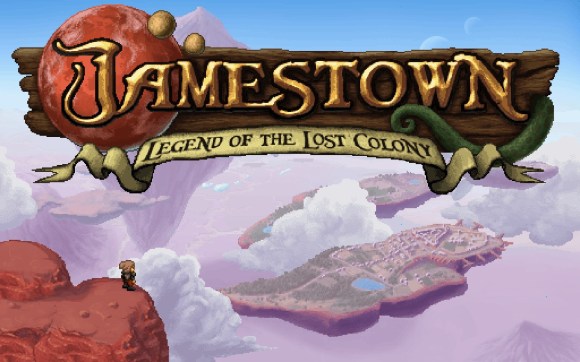
 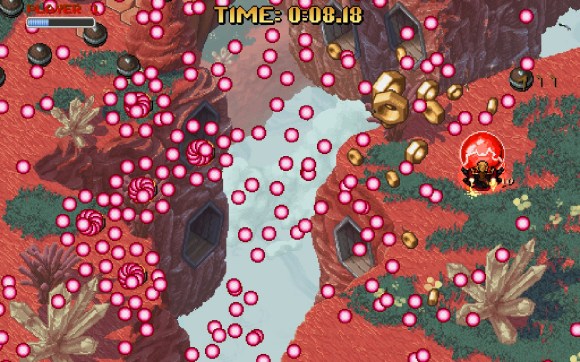 None of this ambitious setup would matter if it didn’t play like a dream: selecting from one of four unlockable ships (bought with ducats, from the “shoppe”), up to four players can collaborate on local multiplayer, flying their steampunk-y ships with keyboards, mice, and as many gamepads as you can cram into your PC (or Mac!). Keyboard control is my personal favourite as Jamestown’s overwhelming bullet-arrays frequently call for precise movement, but the mouse option is certainly appealing, and I can only imagine that play with a gamepad would be nearly sublime. In classic top-down-shooter style you’ll spend the whole game progressing upwards, firing each craft’s signature special weapon while dodging enemies and gathering ducats to activate your score and shield-multiplying “Vaunt” mode. You might even manage to figure out the proper order of destruction that causes each(!) enemy in the game to drop its ‘Special’ bonus points, a trick I still haven’t been able to riddle out for the good majority of Martians and Spaniards. Jamestown is a top-down shooter in the classic shmup tradition: it’s got screen-filling bosses, multiplayer action and more than enough difficulty levels (from Beginner to Divine) to ease anyone into the action – even though the endgame’s minimum difficulty ramps up to (hard-mode) Legendary, making the final level a true bullet-riddled challenge.
 Jamestown is hands-down my favourite recent shoot-’em-up, and one of the best indie games of the year, but like all shmups there are limitations (yes, it’s a word). For one, Jamestown is a short thrill-ride: if you’re playing on Legendary mode (as experienced players will want to), you’ll be through the story in a clean hour and a half or so. I’m no pro, so it took me about four hours, including liberal level-replays to farm ducats for unlockables (of which there are new ships, bonus levels and an alternate, farcical story mode). The multiplayer component of Jamestown is clearly designed to encourage players into the same room as one another, for that additional excitement-factor, but it’s certainly a game that would profit enormously from online play. Jamestown’s shortness is mitigated by its density, including Farce story mode, Gauntlet, Hardcore mode and multiplayer – for many, simply the pursuit of online high-score boards will last them for weeks to come. There’s also the Gunpowder, Treason and Plot DLC ($3) to extend your playtime, which I fully intend to purchase down the line. All in all, Jamestown’s weaknesses are few: if you love shmups, and you don’t mind the brevity of the campaign narrative, there’s a lot to love here, and a whole lot of difficulty levels (and nigh-impossible bonus challenge levels) to chew on.
 Transylvanilla