 Remember Frequency and Amplitude? How about every artsy video-game critic’s favourite springboard, Rez? Those games immersed the player in a synesthetic experience, vastly prioritizing presentation and sensory stimulation over context. In doing so they achieved a singularity of design, uniting form and function (and tactility and audio-visual feedback) into a smorgasbord for the senses – spend time playing either and the veil of input nearly drops away, leaving only player and game in a strange, synesthetic union. Play any of them in a dark room with headphones on and you’re left with a startlingly pure experience, and one that later rhythm games like Guitar Hero struggled to emulate. Gaijin Games knows how it is: BIT.TRIP RUNNER drops right into place, swapping Rez’s Sci-Fi conceit for Atari homage and adding in a healthy dose of absurd, unforgivingly difficult platforming for a startlingly fresh platforming experience.
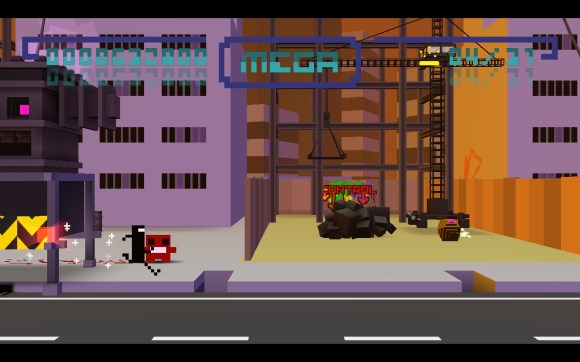
Fourth in its series, BIT.TRIP RUNNER sure looks like a platformer: watching gameplay clips on YouTube, I initially came to the conclusion that it was a quirky and oddly-speedy homage to Pitfall, complete with pretty ambient techno music. Well, I was about half-right. What you can’t tell from the trailers is that BIT.TRIP RUNNER is on autopilot: yes, you’re controlling Commander Video, but he’s more than happy to sprint blindly to his death. Your job is to control his limbs: jumping, sliding, blocking, kung-fu kicking and springing your way past a litany of colourful, pixellated obstacles and enemies. It’s an on-rails platformer, in a sense – every level has a “right” path, with the odd fork over/under an impediment, and if you deviate, you die. Over and over, zapped back to the beginning of the stage, of which there are 36 (with corresponding bonus levels) over 3 worlds. Throughout those 3 worlds you’ll be dodging everything from errant UFOs, to flying balls of sewage, to hopping over outcrops of crystal and kicking piles of boxes in their boxy faces, and should you so much as poke a rock with your toe or kick when you should have slide-hop-blocked, you’re restarting. Again. Simple as that.
So BIT.TRIP RUNNER is fussy – very, very fussy: it has a particular path, and you’re going to find it, or you’re going to ragequit. That’s fine, it injects each level with a sort of quick-draw puzzle element. Like the games whose Atari visuals B.TR pays homage, it rewards practice and repetition. In conversation I’ve likened these trial runs to learning piano: practice makes perfect, but of course the more you practice the more you’ll find ways to mess up sections you thought you had down pat, slowly driving yourself insane. It’s a satisfying sort of intense frustration, but the piano metaphor doesn’t end there: I’ll go on the record right here and say BIT.TRIP RUNNER is nothing without its music. Like its rhythm-game forbears, BIT.TRIP is not as it appears – Rez wasn’t a rail-shooter, Frequency/Amplitude weren’t reflex-testing tunnel-fliers, and BIT.TRIP RUNNER certainly isn’t a platformer.
Immediately upon launch, you’ll notice patron chip-rockers Anamanaguchi playing on the title-screen. Classy. Then, you’ll notice Commander Video’s little pixellated running-sound, then the blips and bleeps that emerge every time you dodge successfully. Then the expanding, electronic soundtrack that deepens and undulates every time you pick up the red floating cross power-ups. After about two levels, once you’re playing confidently, you’ll notice each of these elements synchs perfectly to each level’s background beat, forming an interactive sonic puzzle. BIT.TRIP RUNNER’s grand solution isn’t memorization, it’s a highly-tuned sense of rhythm – watch someone skilled play through a level, and a song emerges. Because the dodge-notes are random, the song changes slightly each replay, and each time you die the track carries right on without you (with Commander Video sometimes waiting for the downbeat to begin his run – a nice touch). BIT.TRIP RUNNER is, secretly, a very well-hidden rhythm game, and like all great rhythm games it is eventually synesthetic, the player’s inputs synching to its soundtrack to immerse the player fully in its gameplay. When it clicks, and the gorgeous (but limited) soundtrack kicks in, playing BIT.TRIP RUNNER is a beautiful aesthetic experience.
 So I like BIT.TRIP RUNNER, it’s true. I’ve always been a sucker for games that prioritize style over substance, and that dearth of substance is occasionally noticeable here too. For one, its short – I’ve put in about six hours, and am on the second-to-last level, but I’ve been taking my time, trying for high scores and generally enjoying the aesthetic. It’s also brutally, at times apparently unfairly, difficult, though failure is always your fault, as the input is flawless (provided you’re working without lag). BIT.TRIP RUNNER demands nothing less than mechanical perfection, and for most players that’s going to take a very long time to develop – in a sense this helps off-put the limited amount of levels. There’s also effectively no storyline, and although exploring the rest of the series will likely remedy that issue, a little context to my hopping would have been nice. More problematic still is that like all great showmen BIT.TRIP RUNNER left me wanting more: more music, different tempos and sound-effects to play around in, more than three worlds’ worth of panoramas to explore. Its immaculately integrated sound-design might preclude user-generated content, but dangit that would be cool too. There’s no stylistic trap-door here that’s going to pull you in if you don’t dig the style either (check a trailer), but if you’re down for some hardcore arcadey action this Holiday season – and Super Meat Boy is a little too gross and cruel for you – you can’t go wrong with BIT.TRIP RUNNER.
8.0
Part 1 of my series on Humble Indie Bundle #4, available here until roughly the 27th. Pay what you want for five fantastic games and downloads of their soundtracks, DRM free, Mac/Linux/PC with Steam/Desura. Pay more than the average (currently about six bucks) for two additional games and soundtracks. The money goes to charity, so there’s no way to go wrong here: I urge you to do this.
Originally published right here, December 2011.
 Time for another album by that band, with the operatic female singer, with the mythological imagery, with the symphonic arrangements and the heavy-metal guitars! Evanescence! Okay, it’s Nightwish, but you get the joke – a band has to work real hard to make a case for itself in female-led symphonic metal these days. When it comes to bands like the two above, the similarities are multitude (though Evanescence technically beat Nightwish to the table by a year): female vocalist, heavy orchestra, operatic vocals, mystical imagery, and a penchant for power chords. The defining make-or-break difference, of course, is ambition: Nightwish is Finland’s most profitable musical export, they were a foundational influence to bands like Epica, they’re charged with crystallizing the female-led symphonic metal genre – in a real sense they helped open symphonic metal to a female audience (and girl vocalists!) without letting it suck. For their last two albums they’ve recruited Pip Williams – the noted orchestral director whom at this point might as well be a band-member – and while doing so mysteriously and
  So I spent this last weekend participating in the free three-day trial of Killing Floor. Whatever notions you might have about a game called Killing Floor are significantly more nuanced and thematically complex than Killing Floor itself, I promise you. This is a game whose average gameplay-session runs to the tune of “Oh look! A zombie. You have shot him; you are in a haunted barn. Now you’re petting the cat. Another zombie! Try and shoot him while calling your girlfriend, or eating some corn chips for the extra challenge!” – they were thought-provoking times, indeed. Yet I found myself drawn to modest Killing Floor, the first-person shooter in a very long and proud history of FPS’s, doing exactly what it loved to do and doing it to the full extent of its slight ambition. I ended up playing a number of hours, hitting a groove, dropping those zombies like it meant something, man, and by the time the trial ran out I was bored and satisfied and moved on with my life. Looking back, though, I sure wish I’d had Blood Lust for my soundtrack.
 Transylvanilla