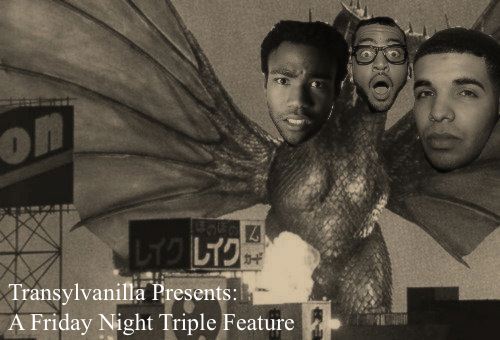
So we find ourselves at the end of another week, a week of media shakeups, disappointed “Community” fans, and unseasonably powerful snow-storms here in the beautiful town of Twin Peaks (Vancouver, too). It was also a heck of a big week for music releases: for some, their predestined album of the year dropped this week in the form of Drake’s Take Care, others will be nursing their post-Community blues by spinning Childish Gambino’s Camp inappropriately loudly, and still more will be pretending it’s still June by purchasing the new Gym Class Heroes. For the record, I love snow, and I don’t watch t.v., so I did a whole bunch of walking. I visited #OccupyVancouver. I watched the cat discover snow again, for the fifth year running. But now it’s Friday night: that means it’s time to make some decisions. It’s time to write a review. Or three.
This week I didn’t cut corners and I didn’t pick sides: it’s time for a Friday Triple Feature.
Look at King Ghidorah up there. Drake looks like he’s sizing you up for a fight, Gambino is so sincere about digesting your apartment building, Travie McCoy is.. well he’s doing a great Travie McCoy impression. That exploding factory is how you’re going to feel when you take on all three of these albums tonight, so let’s start off light (for extra effect, cue up Godzilla on mute and find the parallels). Grab some popcorn, here we go.
° ° °
Really, it’s an interesting week for hip-hop releases. It’s rare that we’re given three works by three relatively prolific artists to work with, and any review of the three can’t help but point out the obvious parallels. Childish Gambino and Drake are both television stars turned rappers, and their hunger for legitimacy permeates their work; not a track goes by on either Camp or Take Care that they don’t stress their authenticity and their subjectivity – these are both deeply personal records, drawing on the secret-weapon of artists whose legitimacy in the hardcore “rap-game” is (rightfully) put into question. Neither of them sling drugs, neither of them have any claim to the hardcore life put forward by forebears like Jay-Z (whom Childish Gambino specifically engages with). They’re both artists whose perceived weaknesses, at least amongst the hardcore audience, are sidestepped on these albums – and to great effect. Gym Class Heroes knows this as well, and as such their pop-rap sticks very strictly to the formula that won them their fame, likewise avoiding the legitimacy-trap of the hardcore hip-hop culture.
Of additional note is bi-raciality: Drake is half Jewish, and his life thus far has hardly been representative of the African-American experience that plays so heavily into hip-hop as a genre. Gambino relentlessly plays off his role as a half-white kid, and the bullying he received on account of it, turning his past pain into present strength. Gym Class Heroes are a mix of racial groups, combining hip-hop and straight pop music to engage a greater cultural audience, and have been met with positive reception across both core groups. What we’re met with in all three of tonight’s performers is the seminal figure of the idiosyncratic underdog. They all know they’re different, and as they turn their difference into strength the resulting product inevitably emerges as an oddity. As a reviewer, I love this kind of stuff. This week we have on our hands three albums, all ostensibly about girls, all produced by wildly various artists, and all of whom are fighting desperately to carve (or secure) their niche.
Do they succeed? Well, that’s another story.
° ° °

Gym Class Heroes – The Papercut Chronicles II
As I said, we’re starting off light: The Papercut Chronicles II is by far the easiest listen and easiest review of tonight’s three features. Track one tells us everything we need to know about Gym Class Heroes circa 2011 (and ’06): “I’d like to think I pride myself on being humble/And let these other motherf-ers lose touch like a fumble/‘Cause you can keep a level head and have fun too”. It’s a mission statement, it’s a summary of the album, it’s basically their philosophy as a group. Gym Class Heroes have always given the impression that they’re speaking to their teen selves (their major audience), and they don’t abandon that tried-and-true sensibility here. “Life Goes On” reminds you that life does, in fact, continue, and is one of several tracks on this album featuring a chorus by a female singer you’ve never heard of (they all handle themselves very well, mind). “Martyrial Girls”, with its speedway synth-y guitar loop and open self-consciousness in the face of the over-saturated fashion-culture of hip-hop that the ‘Heroes openly reject, is the album highlight, handily incorporating the pop hooks and pop-punk chord structures that have come to define these guys. “Stereo Hearts” is a track you’ve heard hundreds of times already without realizing it was a Gym Class Heroes track (and alongside Adam Levine’s feature, this confirms that you’ll be skipping it every single time). “Lazarus, Ze Gitan” just really wants to be Common’s “I Used To Love H.E.R.”, but with Travie’s basic lyricism it simply can’t be – though it isn’t like they’re the first group to fail that test. All three of tonight’s albums beg repeat listens – but in The Papercut Chronicles II’s case, do those repeat listens really reward the listener?
Well, no, not really. You’re not going to be digging for extra depth here. The lyrics are open admissions of adolescent frustration, the hooks are recognizable and obvious (“Solo Discotheque” sounds like a Mobile song, for better or worse), while the live rock instrumentalism ties everything together nicely enough. Live backing-bands in hip-hop are awesome, and they give Gym Class Heroes an honesty and down-to-earth feel sorely missing in the present pop scene’s fascination with heavy electronic production, and it is their saving grace. That being said, as a hip-hop fan, it’s difficult not to find the poetry lacking. “Holy Horseshit, Batman” emerges as one more juvenile rejection of judgmental, street-corner Christians. “You won’t save me, don’t pray for me” comes off as woefully obvious punkery and it utterly lacks depth – this is on a track where Travie denies Christianity, but on an album with several clear references to God and at least one very odd comparison to the visage of Christ. I can go on at length complaining about weak lyricism here, but it’s important to note that I’m not the target audience; I’m so far outside the target audience I’m not even in the reticule or radar (or am I?). This is fun music for parties. Warped Tour. Summer. Which is why it’s utterly astounding that this album came out at the cusp of Winter. Whoops.
The production hums along nicely, I can dig the choruses, and (as teens of the 00’s) we’ll always have a certain soft-spot for these sorts of obvious adolescent rebel-anthems, but I can’t sugar-coat this one any further. The Papercut Chronicles II might serve you perfectly well at a party, but it sure would be cool if these guys would mature a little – live instrumentation combined with the sort of emotional depth our next two artists are about to bring would make for some really neat music (The Roots, anyone?). Tonight, this is the album that seems to be all about limp rebellion and liking girls, and, um, actually is. Why try harder?
C+
° ° °
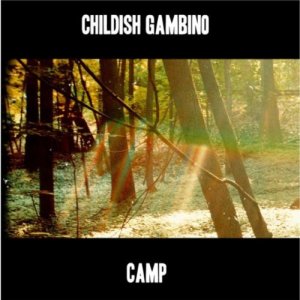 Childish Gambino – Camp
Remember what I said about live instrumentation, and how it can ground an entire album, take the subject matter and make it real? Camp, co-produced by Gambino and “Community” composer Ludwig Göransson, is the most beautifully instrumental hip-hop album of the year. You can quote me on that – I’m not even going to contradict it when I review Drake, which is a feat. Musically Camp is absolutely gorgeous – take a minute and listen to “Outside” right now. Tingles just ran up your spine, didn’t they? “We used to say ‘I love you’ – now we only think that shit/it feels weird that you’re the person I took sink-baths with/street took you over, I want my cousin back/The world sayin‘ what you are because you’re young and black/Don’t believe em’ – you’re still that kid that kept the older kids from teasin’/for some reason… ”. What more can I say to that? Donald Glover grew up, in the South, a Ghostface Killah fan, and at his most confessional that influence shines through. It’s details like sink-baths and jaw-dropping lines like “She see what she wanna see – so I make her take Plan B in front of me” that expose a Childish Gambino that’s really grown as an artist since the straight hour of hype-tracks and half-baked love songs he brought forth on Culdesac.
The subject of matter on Camp oscillates wildly between intimate confessions, prankster brags (Childish Gambino’s absolute specialty), and indefensibly misogynistic caricatures of his sexual life.. or at least they would be, if this weren’t a concept album. As a side note, I’m not an apologist: lines like “Shut your mouth before I fuck it” are absolutely vile, out of context. I’m not here to defend that – but I am here to defend artists like Tyler, the Creator, whose presence looms heavy over tracks like “Bonfire” (and its incredible video) and in the darkest corners of this surprisingly grim album. On my first listen-through of Camp, I hated Gambino: there are a total of three women on this album presented as anything more than utter objects, on the tracks “Letter Home”, “That Power” and “Kids“. And then I listened again. And again, and again. At the end of the day Camp ended up being, by far, the most difficult review I’ve ever written. After repeated listens through the first and final tracks, a narrative emerges. Viewed through the lens of a concept album, as the story of a young, angry, bi-racial man growing up under the pressures of scrutiny, racist bullying (a constant theme here), and female rejection throughout his childhood and adolescence, Camp‘s thematic content falls into place. Childish Gambino’s most fascinating album is a character study, a portrait of a rampaging id devouring women and critics on every track, and very rarely coming up to breathe.
To give away Camp’s grand reveal on the final track is to ruin the narrative, which neatly folds in upon itself in a climactic spoken-word passage drawn directly from Glover’s own childhood experiences. Established in the first track through the anecdotes of Gambino’s development (which are echoed via blink-and-you’ll-miss-them asides throughout the rest of the album), his character slowly takes form. Camp’s ultimate success occurs the moment the listener realizes that this arrogant jerk, this furious young man with his ugly imagery and his graphic vivisections of his (apparently massive) collective of female partners, is reminding you every moment of this album that he is relentlessly self-aware, that he acknowledges the self-destruction of his habits and persona – he desperately longs for a meaningful relationship that he finds himself unable to cultivate.
It’s heady stuff, but how does it sound? Gorgeous, usually – the synthesizers on “Heartbeat” quickly withdraw from the Justice homage they set up, “Backpackers” recalls Kanye West’s “Runaway”… until the brooding synths drop in, lurking in the shadows like a Viktor Vaughn beat. Violins redeem the irritating sung chorus on “L.E.S.” (“Meet me in the bathroom, girl…”). In fact, the production frequently comes to the rescue of Gambino’s singing, which never reaches the imaginative heights of his one-liners, which are relentless. Childish Gambino, whose name comes from a Wu-Tang Clan name-generator (of course), is the post-modern prankster. He can’t go more than thirty seconds without dropping a cultural referent of some sort, and this provides the majority of his mainstream lyrical appeal: “Freaks and Geeks” isn’t on this album (too happy), but it crystallizes Gambino’s trademark flow, which filters through to every track here. If I begin quoting the memorable lines, I won’t ever be able to stop. Donald Glover is a geyser of clever quips, which on Camp are tempered remarkably well with his socially-conscious critiques and, yes, the constant sexism.
If it seems as if I’m having a difficult time addressing Camp directly, you’re onto something. Childish Gambino has dropped a far more nuanced and multifaceted album than I think any of us were expecting. When it fails, it fails: the sung choruses are frequently lame and the constant barrage of anger, exclamations and sexual imagery is undoubtedly going to shove many listeners away (not to mention limit his radio appeal). When Gambino gets down to the business of attempting to express his legitimate romantic feelings, he comes off stilted; he’s obvious, he’s awkward, he says basic things like “sometimes that dumb shit IS the real shit”, he rips on backpack-rappers while, of course, becoming one. “Outside” promises a progressive album that never actually materializes – it’s the springboard into Gambino’s extensively dark, yet ultimately resolved, self-portrait. He lives in an uncomfortable world of sex and aggression and infidelity, and if any part of that can still make you uncomfortable (at times, it should), then yes, you might be just as furious at Gambino as I was after my first listen.
Camp is extensive and frustrating and disorienting and difficult. It is also socially relevant, bleak, occasionally depressing, confessional and frequently gorgeous. If you look down my list of reviews here, you’ll find another hip-hop album, released this time last year, that merited all those same adjectives. That album won album of the year. Will Camp? Well, no: it isn’t a masterpiece, it’s clumsy and repetitive. However it is also fascinating, and infinitely more interesting than anyone was expecting from Donald Glover of “Community” fame. I have a fascination with modern dark and introspective hip-hop – an era that Kanye West ushered in with 808s and Heartbreak, a connection that Gambino is quick to acknowledge – and this fits the bill. This is the most difficult review I’ve yet written, and that’s why it’s so damn long. Camp is a magnificently flawed gem, and it’s one of the most interesting albums of the year. It is one of my favourite albums of the year. Please give it a try.
A-
° ° °
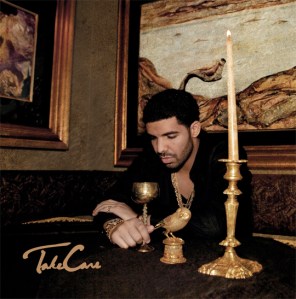 Drake – Take Care
Finally we come to Drake: just three years younger than Childish Gambino but, as we can surmise from his gloomy album art, just as overwhelmed by his sudden success. Unlike Gambino though, who treats his excellence like a god-given right (which is the same way he treats Asian girls, apparently), Drake’s already got a platinum album under his belt: he’s been there and done that, and he’s roughly as amazed as you are. You’d be forgiven for assuming (as I did) from the album art that this is his victory lap, Drake’s opportunity to more or less bask in his success, lazily pumping out sequels to his sleepy non-sung debut album. Turns out we were wrong. Sure, Drake’s success takes center stage here, but not in the way you’d expect – Take Care is very much a relationship album, firmly centring itself in and around the emotional pitfalls that come with the riches and the glory. Drake will be the first to admit that he hasn’t adapted well to fame, and that authenticity combined with his newfound abilities to rap (!) and write nuanced lyrics (!!) makes for a Drake album very much worth hearing – and I’ll be the first to admit I never thought I’d type that sentence.
Take Care sprawls. It’s almost an hour and a half long. If you already like Drake, go and buy this right now, because it’s twenty tracks (counting the two bonuses) of mildly-auto-tuned slow-jams that range thematically from heartbreak, to womanizing, to the alienation and isolation of fame – it is a good deal. What about the mature listener, that doesn’t want an hour and a half of Drake whining about his lost girlfriends? Amazingly, that isn’t what he gives us: “Marvin’s Room” manages to recall Gambino in it’s cruelty as a self-destructive sabotage of an ex’s new relationship, “Take Care” is a highlight as Rihanna stops by to despairingly discuss the relationship she and he once shared (“you’ve seen all my mistakes, so look me in my eyes”), “HYFR” gives us Drunken Drake – a commonality on this album – woozily bragging his way through an evening that does more than enough to convince you he might be living a little unhealthy. Things even manage to get completely bizarre on the fever-dream intro to “Buried Alive Interlude”, which gives us Drake bragging about sex, but over a hazy beat that refuses to allow the braggadocio to stick; what we’re left with is isolated and self-aware narcissism, a man that knows he’s digging his own grave with excess.
In a sense, the whole album sounds like this: it’s absolutely full of gorgeous production, headed by Noah “40” Shebib, that is intimate and hazy, it’s isolating and lonely without ever growing cold or comfortless. Take Care is an album full of brags and taunts, but curiously devoid of anger: Drake isn’t interested in convincing you he’s the best or that he’s rich, he simply assumes you already know – he’d rather tell you about his empty sex life, or about how hard he’s worked to get here, or about what it’s doing to his willpower (“We’ll Be Fine”). Oh, and Drake-as-Artist has arrived: Drake can actually rap now, and it’s frequently impressive (though his singing remains firmly, firmly monotone). Drunken Drake speaks to a hypothetical woman on “The Real Her”, sighing that “You got a past an I got do too, we’re perfect for each other” over distorted piano tones, as he enthuses over the crushing repetition of empty relationships on the road. Lil Wayne and André 3000 both show up on this track too, and it’s a credit to all three of them that they succeed in keeping things low-key and introspective; “I know this aint your first, but it’s better than your last” Wayne tells her, André mentions he’s been spending his melancholy hours listening to Adele. “You must have done this before, this can’t be your first time..” Drake moans over the chorus, yet when he does so it emerges more admission-of-guilt than any sort of compliment, as if he has trouble recalling which city, which girl, he’s with. When Drake does decide to briefly abandon the topic of girls, it’s to thank the woman that raised him on “Look What You’ve Done”, a track so fantastically filled with small details that one can’t help but feel for him (even as he brags of his own success). As he says: “And then you ash it, and we argue about spending money on bullshit/And you tell me I’m just like my father, my one button you push it/Now it’s “Fuck you, I hate you, I’ll move out in a heartbeat”. We can’t argue that Drake doesn’t know how to rap anymore, he’s taken the time to radically improve his skills – after this album, he’s officially allowed to call monotone his thing. On Take Care, he actually makes monotone rap work to his favour.
And that’s it: Take Care doesn’t take time to radically expand beyond it’s patron subject matter of girls, glory, sadness and loneliness, nor does it have to. Take Care is romantic enough for a date, however (and this is important), it’s also nuanced and mature enough for solo listening. It’s R&B that’s also hip-hop. It draws in various narratives and characters, dedicated to extending it’s limited subject matter as far as possible, under a pervasive umbrella of intimate yet melancholy production that has a way of undermining even Drake’s most macho verses. It is an absolute credit to Drake that I, someone who can’t normally enjoy modern R&B, have found this album worth spinning more than once. Drake won’t score any points for novelty here, but what he does, he does exceedingly well. The modern romance-album is a sad, confused thing, and it isn’t quite sure what to do with itself in a supremely commodified landscape of guns, cars, money and empty people. It makes for an exciting listen.
I can’t help it. I have to give it an A.
° ° °
…And so we complete our Friday Night Triple Feature! Remarkable! Stand up, stretch your legs. We just listened to a whole bunch of Drake, so it might be time for a short nap. I think the cafeteria guy outside can probably hook us up with coffee too.. Do you have a ride home? Oh, that’s great! Okay. Well, I’ll just be taking the bus. Bye! No no, I’ll be fine! See you guys later!
Originally published right here, for it is far too long for any other venue. November, 2011.
 Ten years ago my oldest friend and I went down to Metrotown, a giant mall here in Vancouver. We wandered around for a while before hitting up the A&B Sound that used to be next door, which at the time was the joint for folks in search of cheap media. Forty bucks and a couple of hours later, he was the proud owner of Ninja Scroll. I took home Ghost in the Shell. A couple weeks later I bought more. And more. Later I’d discover online streaming, and scan-lated manga online, and then American comics, and then a class full of all that awesome stuff in University. That day, we’d begun our journey into full-on suburban white-kid anime obsession. Flash to present day and I’ve still got that copy of Ghost in the Shell – and it’s publisher, Manga Entertainment, is twenty years old. Did viewing Ghost in the Shell and Ninja Scroll at my young and impressionable age deeply alter my perspective on illustrated storytelling, the Japanese aesthetic, and foreign media in general? Absolutely. I’m not the only one, either: this autumn the appropriately-named Akira The Don drops his tribute to twenty years of Manga Entertainment, the studio that helped open the minds of (and in some cases defined) an entire generation of Western kids. Enter ATD 26: Manga Music.
 Transylvanilla