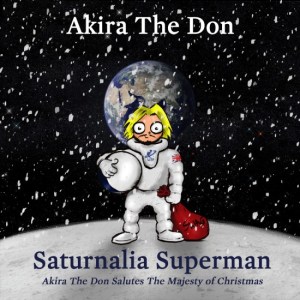
 Hey, Adam Narkiewicz came out with another LP today (okay, yesterday), less than three months after his last one! And he’s dropped it right in the middle of Saturnalia itself, how thematically appropriate! I don’t have to go through the walkthrough this time: if you love Akira’s stuff, and you have to be a special kind of person to do this, you will have a big silly grin on your face for much of Saturnalia Superman. It’s as simply as that: fans can’t not cackle at the Nutcracker Suite sample on “Jimmy Savile Swag”, they can’t not smile at the album’s opener “A Very Merry Ho Ho Ho” when he wishes his mother and father “and their new respective partners” a very merry Christmas. He’s infectious and ineffably positive, and the cult of personality is in full effect – even when Saturnalia Superman takes some surprisingly thoughtful and unconventional twists towards the end.
Musically, Akira’s in control on this one: he covers a good 90% of the verses this time around, flipping between the feel-good hollering of “A Very Merry Ho Ho Ho” and his trademark political flows on “Ha Satan” with ease (on what might be his most politically-charged track since “Thanks for All the AIDS“). “Jimmy Savile Swag” (Westerners, go wiki who that is) rides that hard-leaning two-step beat everyone loves these days, and Akira’s infatuation with autotune continues make an appearance. Its presence is most obviously felt on the eyebrow-raising Envy feature “Sexmas”, which is entertaining and meandering and ends with Envy reminding us she’s “going to heat it up like a Mincemeat pie” amongst other bizarre Christmas-related sex-threats (“wrap you up with Fairy Lights, it’s gonna be good”). As on ATD 26, while autotune rears its blocky head every couple of tracks, it’s very clearly a stylistic decision: Akira’s (and Envy’s) voice flutters, it bounces around, and unlike so much autotuning it’s no attempt to fake anyone’s way into opera-level virtuosity. It’s a level of honesty and earnestness that Akira brings to all his work these days, and as on his other albums it goes hard at work, grounding Saturnalia Superman and providing a great deal of his appeal.
Clanging bells and other Christmas jolliness pervade this album (“A Christmas Movie”), but it isn’t without its surprises: most of Akira’s version of “Bleak Midwinter” is a surprisingly heartfelt vocal duet by Akira’s Cornish Welsh in-laws, proceeding a cappella before the piano, flute and strings kick in and set off what eventually builds into the album’s most beautiful track. “Bleak Midwinter” falls mid-album, and precedes another nine-and-a-half minute surprise: “17 Year Old Blonde Girl And A Bottle of Acid”, featuring a man named Issue, who really cannot sing (thankfully, he seems to know this). Like its title might suggest, it’s a trip: what begins as an odd bit of hood-meandering by Issue quickly breaks down into a heartbreaking ode to a forgotten female trip-mate, delivered by Akira himself. The album’s greatest and most sobering moment, it’s a strange and thought-provoking piece, sprawling its narrative across several harrowing minutes and telling a story that isn’t always easy to hear. When Akira tells us that he’s opening Christmas presents with his mum and little brother and the “wrapping paper seem[s] to crawl up [his] arm like tentacles” the psychedelic imagery combines with our notions of Christmas’s assumed innocence to shock and disorient the listener. It’s extremely effective stuff, and lends heavy dosage of reality to the typical Christmas Album format. In a sense, all of Saturnalia Superman follows this model: simultaneously celebrating the holiday season (and life!) while offering thoughtful reminders of its reality – murder, drugs, rampant commercialism and Akira’s trademark resolution to carry on (closer “In The Morning”) all make appearances here.
Of course, Saturnalia Superman wouldn’t manage to be an ATD LP if it didn’t somehow pull off being a party, even in its bleakest moments. It isn’t his most consistent album – much of his merry band of thieves is missing (can we imagine Christmas Big Narstie? Let’s.) – but Saturnalia Superman can’t help being an enjoyable time, even in its more experimental and meandering moments. Another solid entry in the ATD catalogue (though not strictly ATD 27), Saturnalia Superman is supremely topical during the season, and offers several tracks destined to prove their staying power in the Akira catalogue. It goes by quickly, a widely various series of Christmas-themed sketches in the life of one more dude trying to get by. It’s an Xmas album for people that live in the real world, who’ve had experiences, that aren’t much for major commercialism and don’t know what to think about God but know they like hip-hop and spending time with their folks. How much more can we ask for for Christmas than that?
7.5
Bonus Level:
Saturnalia Superman As a Christmas Album is a grand triumph, intelligent, heartfelt and earnest. As a simultaneous lover and critic of the Christmas season, this sort of thing really does it for me. I do love it, but in the above review I had to acknowledge its faults. As a big Akira fan and a big Christmas fan, though, I have to say this is definitely going to be spinning all holiday season. Much more interesting, dense and listenable than any Christmas album I’ve heard in years. Highly recommended.
Based solely as a Yuletide experience, Saturnalia Superman gets a coveted 4.5/5 baubles. Do with that as you will.
Akira the Don provides many of his services over the internet: his website is here, and he would love it very much if you’d cop a free listen off the stream, and then buy yourself some copies.
Originally published right here, December 2011.
 Time for another album by that band, with the operatic female singer, with the mythological imagery, with the symphonic arrangements and the heavy-metal guitars! Evanescence! Okay, it’s Nightwish, but you get the joke – a band has to work real hard to make a case for itself in female-led symphonic metal these days. When it comes to bands like the two above, the similarities are multitude (though Evanescence technically beat Nightwish to the table by a year): female vocalist, heavy orchestra, operatic vocals, mystical imagery, and a penchant for power chords. The defining make-or-break difference, of course, is ambition: Nightwish is Finland’s most profitable musical export, they were a foundational influence to bands like Epica, they’re charged with crystallizing the female-led symphonic metal genre – in a real sense they helped open symphonic metal to a female audience (and girl vocalists!) without letting it suck. For their last two albums they’ve recruited Pip Williams – the noted orchestral director whom at this point might as well be a band-member – and while doing so mysteriously and
  So I spent this last weekend participating in the free three-day trial of Killing Floor. Whatever notions you might have about a game called Killing Floor are significantly more nuanced and thematically complex than Killing Floor itself, I promise you. This is a game whose average gameplay-session runs to the tune of “Oh look! A zombie. You have shot him; you are in a haunted barn. Now you’re petting the cat. Another zombie! Try and shoot him while calling your girlfriend, or eating some corn chips for the extra challenge!” – they were thought-provoking times, indeed. Yet I found myself drawn to modest Killing Floor, the first-person shooter in a very long and proud history of FPS’s, doing exactly what it loved to do and doing it to the full extent of its slight ambition. I ended up playing a number of hours, hitting a groove, dropping those zombies like it meant something, man, and by the time the trial ran out I was bored and satisfied and moved on with my life. Looking back, though, I sure wish I’d had Blood Lust for my soundtrack.
 Transylvanilla